UV-Curable Acrylic Resins: Benefits for Coatings, Inks and Adhesives
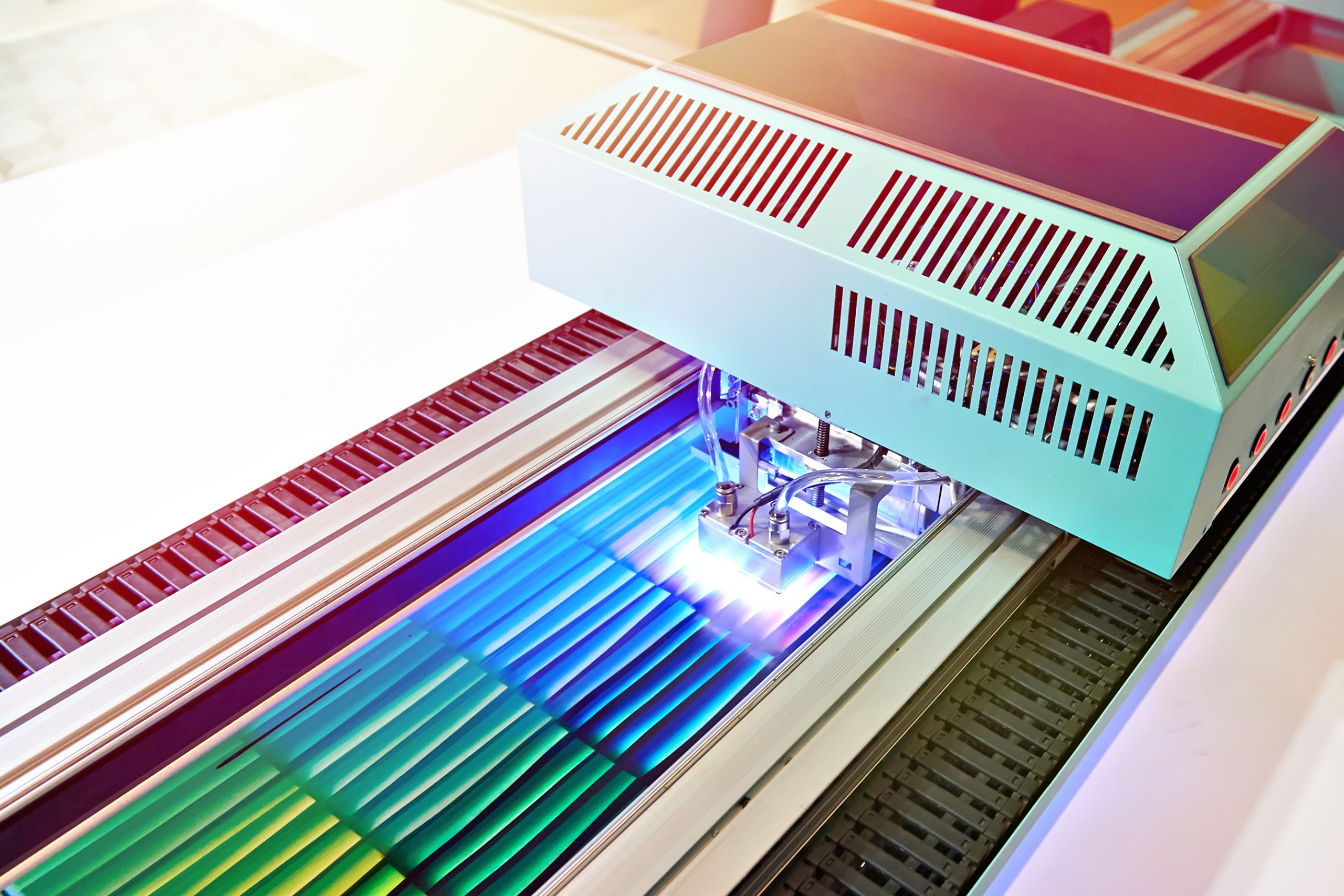
UV-curable systems offer formulators rapid curing and the ability to develop high-performance coatings, inks and adhesives while supporting lower-VOC and solvent-free formulation strategies. But achieving the right balance of cure response, adhesion, flexibility, hardness, chemical resistance, viscosity and cure shrinkage remains a complex formulation challenge.
UV-curable acrylic resins provide formulators with another tool for controlling these properties.
Depending on the resin chemistry and formulation, acrylic polymers can help reduce cure shrinkage, enhance adhesion, adjust viscosity and flow, improve flexibility, and contribute to the overall performance of the cured system.
Elvacite™ acrylic resins include both performance-modifying and UV-reactive technologies designed for use in radiation-curable systems.
Acrylic resins are highly transparent, amorphous synthetic polymers generally based on methacrylate chemistry. They are widely used in coatings, inks and adhesives because they can contribute to transparency, weather resistance and a useful balance of mechanical properties.
Within UV-curable formulations, acrylic resins can act as performance enhancers and formulation modifiers. UV-reactive acrylic resins are distinguished by reactive groups that allow the acrylic polymer to become incorporated into the polymer network during curing. This combines useful acrylic characteristics with the performance possibilities of a crosslinked UV-cured system.
Developing an effective UV-curable formulation often means balancing several competing requirements. A coating may require hardness while retaining flexibility. An ink may need pigment dispersion and controlled viscosity along with good adhesion. An adhesive may require low shrinkage, clarity and resistance to environmental conditions.
Acrylic resins provide an additional way to adjust this balance.
Depending on resin chemistry and formulation, potential benefits include:
Compatibility and performance depend on the specific acrylic resin, reactive monomer package, concentration and processing conditions, making formulation-specific screening essential.
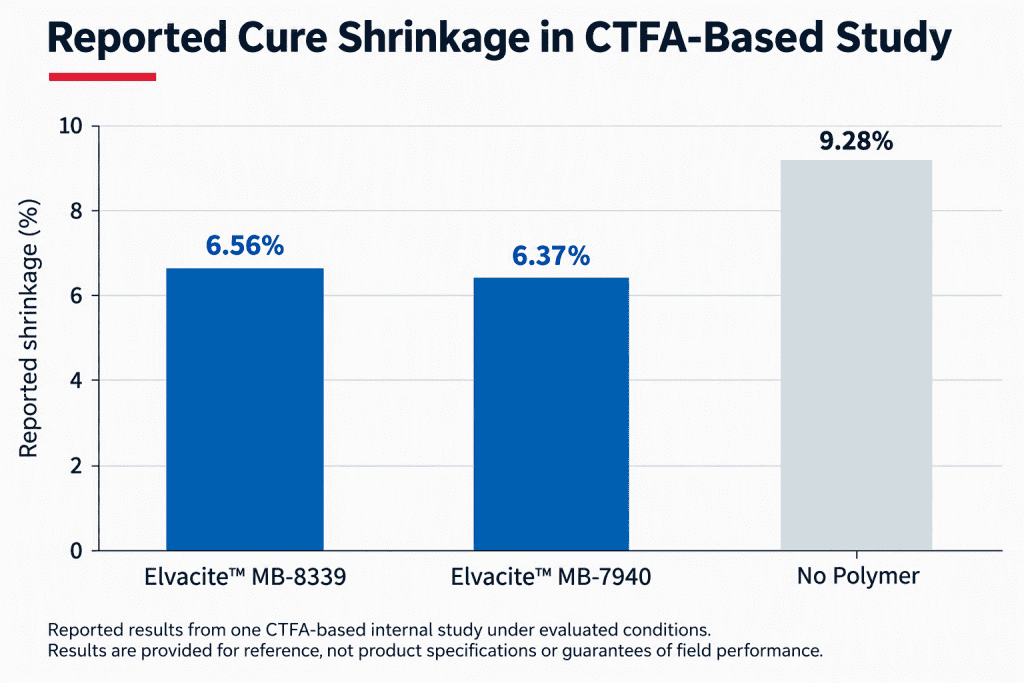
Curing shrinkage can affect dimensional stability and introduce stress into a cured film. Acrylic resins can help formulators control shrinkage within UV-curable systems.
Internal testing illustrates the effect. In one CTFA-based study, formulations containing Elvacite™ MB-8339 and Elvacite™ MB-7940 produced reported shrinkage values of 6.56% and 6.37%, respectively, compared with 9.28% for the formulation containing no polymer under the same reported conditions.
These results demonstrate why acrylic resin selection can be an important consideration when low cure shrinkage is a formulation objective.
Good substrate adhesion is critical for UV-curable coatings, printing inks and adhesives.
Internal cross-cut evaluations of acrylic binder formulations demonstrated strong adhesion on several common plastics under the tested conditions. Reactive acrylic technology can further support adhesion by allowing the acrylic polymer to become bonded into the cured polymer network.
For formulators working across different substrates, resin architecture and compatibility with the overall UV system should therefore be considered alongside the required adhesion performance.
Hardness and flexibility frequently compete within coating and ink formulations. A cured film needs sufficient hardness for surface performance without becoming excessively rigid.
UV-reactive acrylic binders can help balance hardness and flexibility while maintaining relatively low cure shrinkage.
Elvacite™ UV-reactive resin technologies were developed with mechanical performance, adhesion and reduced curing shrinkage among their formulation objectives.
UV-cured coatings, inks and adhesives may encounter solvents, cleaning agents, acids or alkalis during use.
In internal evaluations, binders containing UV-reactive acrylic functionality improved solvent resistance compared with the non-reactive acrylic reference and also demonstrated acid and alkali resistance.
Because actual performance depends on the complete formulation and end-use environment, chemical resistance should be evaluated under application-specific conditions.
Acrylic polymers are valued for transparency and weather resistance. Incorporating UV-reactive acrylic technology allows formulators to bring these acrylic characteristics into systems that may also require flexibility, moist-heat resistance and durable performance.
These properties can be particularly relevant when optical appearance and longer-term environmental performance need to be considered alongside mechanical properties.
Acrylic resins can be compatible with a variety of radiation-curable monomers and oligomers, but compatibility depends on the specific combination of resin and reactive components.
Internal screening reported complete dissolution of Elvacite™ MB-8339 and Elvacite™ MB-7940 in:
Elvacite™ MB-8339 also dissolved completely in IBXA, while Elvacite™ MB-7940 showed slight haze. Both grades showed slight haze with DPHA under the reported test conditions.
Both grades were also reported as compatible with a urethane acrylate oligomer in tested formulations containing CTFA, IBXA and THFA.
These results reinforce the importance of resin-monomer and resin-oligomer screening when selecting an acrylic polymer for a UV-curable system.
Potential applications include hard coatings and conformal coatings. In UV-curable coatings, acrylic resins can influence cure shrinkage, adhesion, flexibility, hardness, clarity, chemical resistance and weather resistance.
The combination of low shrinkage, clarity and mechanical performance can make acrylic resin technology useful when multiple coating properties must be balanced within the same formulation.
Acrylic binders can also be used in UV inkjet and UV flexographic printing applications.
Beyond cured-film properties, acrylic functionality can influence pigment dispersion. Internal testing found that an acid-functional acrylic resin produced a low-viscosity pigment dispersion and a high-gloss cured film in the evaluated formulation.
Acrylic binder technology therefore gives formulators another variable when balancing pigment dispersion, viscosity, gloss, adhesion and cured-film performance.
Acrylic resin technology can support UV-curable bonding systems for glass, plastics and metals. Relevant properties can include low shrinkage, weather resistance, moist-heat resistance and substrate adhesion.
Potential pressure-sensitive adhesive applications include optically clear adhesives and fixing tapes, where properties such as cohesive strength, clarity, weather resistance and heat resistance may be important.
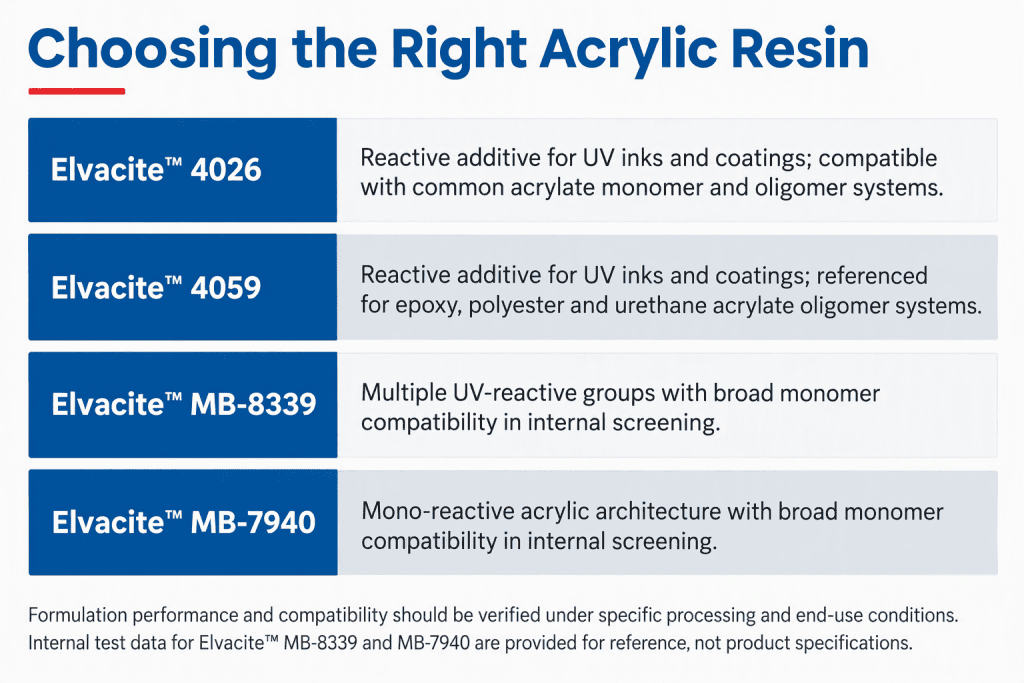
Different acrylic resin architectures give formulators different approaches to modifying a UV-curable system.
Elvacite™ 4026
A UV-reactive performance additive for UV-curable inks and coatings. It is referenced as compatible with common acrylate monomers including TPGDA, HDDA, TMPTA, TMPEOTA and EOEOEA.
Elvacite™ 4059
A UV-reactive performance additive for UV-curable inks and coatings whose polymer technology is designed to integrate into the polymer network during cure. Technical information also describes its use with epoxy acrylate, polyester acrylate and urethane acrylate oligomers.
Elvacite™ 4026 and Elvacite™ 4059 can provide the following formulation benefits:
Elvacite™ MB-8339
A bead resin technology containing multiple UV-reactive groups. Internal screening demonstrated broad monomer compatibility under the evaluated conditions. Reference properties provided in the technical material include a weight-average molecular weight (Mw) of 16,000 and Tg of 75°C.
Elvacite™ MB-7940
A mono-reactive acrylic bead resin architecture that also demonstrated broad monomer compatibility in internal screening. Reference properties provided in the technical material include a weight-average molecular weight (Mw) of 7,000 and Tg of 105°C.
These reference properties are not product specifications, and resin suitability should be evaluated for the intended formulation and processing conditions.
There is no single property that determines the success of a UV-curable formulation. Cure response, shrinkage, adhesion, flexibility, hardness, clarity, viscosity, chemical resistance and compatibility may all have to be considered together.
Acrylic resins give formulators an additional means of controlling that balance.
Depending on resin architecture and formulation, acrylic technology can contribute low shrinkage, strong adhesion, balanced hardness and flexibility, high clarity, chemical resistance, weather resistance, compatibility with UV components, viscosity control and pigment-dispersion performance.
The key is selecting an acrylic resin architecture that complements the monomers, oligomers, pigments, substrates, and performance requirements of the intended application.
Get in touch with the Elvacite technical team to discuss your formulation requirements. The Elvacite website currently positions its team as providing technical support for resin selection, process efficiency and resin performance.
Technical disclaimer: Formulation performance and compatibility should be verified under specific processing and end-use conditions. Results referenced in this article are based on internal testing and are provided for reference; they should not be regarded as product specifications or guarantees of field performance.